
art
Orpheus and Eurydice
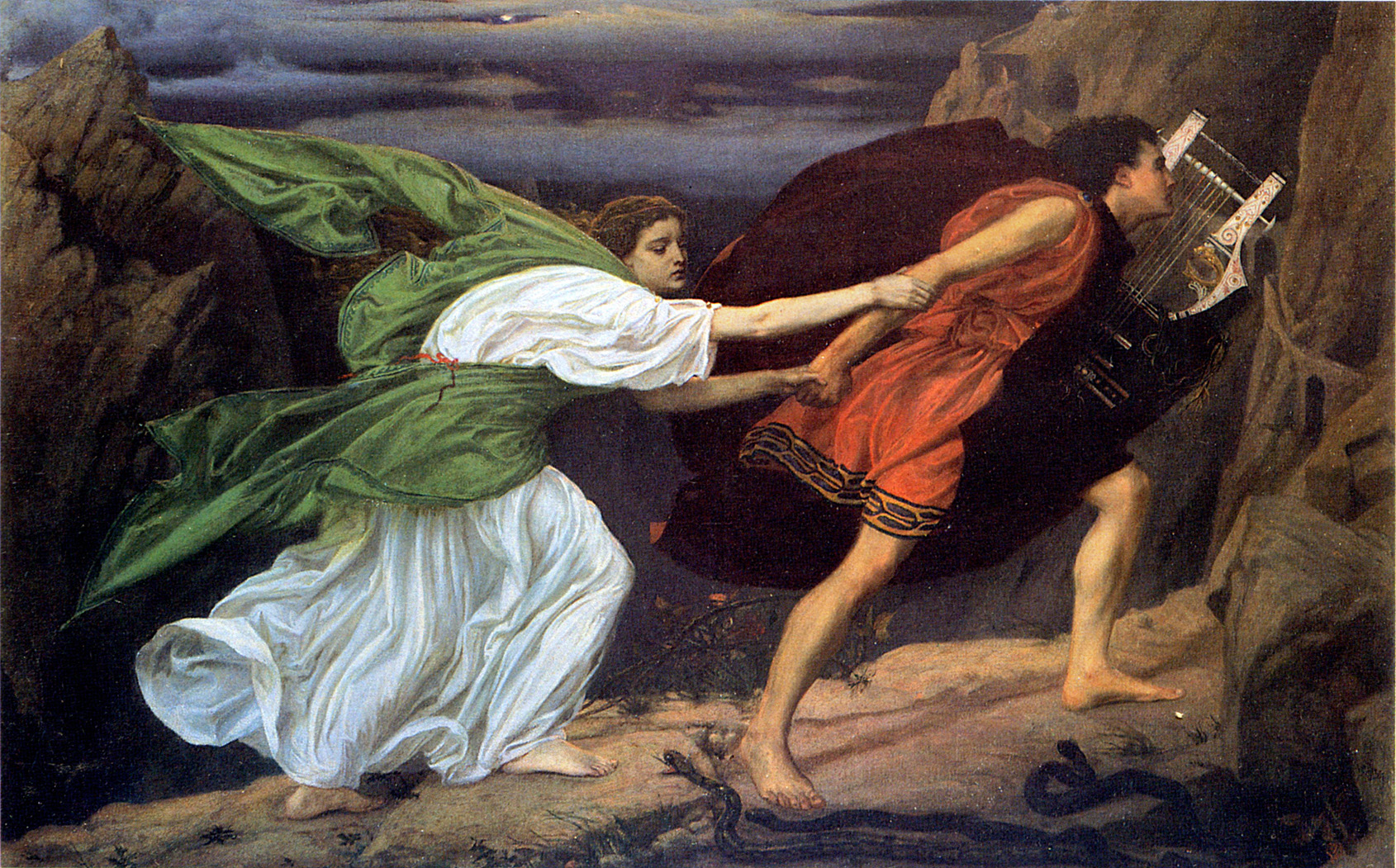
Edward Poynter stages Orpheus leading Eurydice out of the underworld, with her reaching toward him as he moves into an uncertain light.
Source / attribution: Wikimedia Commons — Edward Poynter, Orpheus and Eurydice
At first, the painting looks like a rescue caught in motion. Orpheus leans forward with his lyre strapped across his back, one foot already carrying him toward the edge of the rocky passage. Eurydice reaches for his arm from behind, her white dress and green cloak spreading across the dark ground. Her body seems to move with him, but her face turns toward the person who is leading her away.
That tension is what makes the image work. Orpheus is a figure of forward movement: the red cloth around him cuts through the grey and violet landscape, and his hidden face refuses to give us a reassuring expression. Eurydice is brighter, almost ghostlike, but she is also the figure pulling our attention back into the scene. The lyre makes the rescue possible, while the cramped rocks and heavy sky remind us that the underworld has not fully released them.
Poynter does not paint the final instant as a spectacle. He gives us the dangerous seconds before it—the moment when trust has to hold, when one person must keep walking without proof that the other is still there. That is why the painting stayed with me after watching Why Do So Many Myths Say “DON'T LOOK BACK”?. The myth's warning becomes visible as a physical struggle between moving forward and reaching back.
